1. The Ancestral Game: The Roots of Caid
Since the 14th century and with formal records in the 16th century, various traditional ball games known collectively as Caid were played in the rural areas of Ireland.
-
No Clear Limits: Matches were contested between neighboring parishes or towns, often involving dozens of men on each side.
-
Open Field: There were no fixed dimensions for the field or standardized goals; boundaries were usually natural landmarks like trees, streams, or property lines.
-
Hybrid of Skills: Players were allowed to carry and strike the ball with both hands and feet to take it to an agreed target.
2. Institutionalization and Cultural Renaissance (1884)
By the late 19th century, the growing expansion of Victorian sports (such as association football and rugby) threatened to extinguish Irish pastoral traditions.
-
The Foundation of the GAA: On November 1, 1884, Michael Cusack and Maurice Davin founded the Gaelic Athletic Association (GAA) in Thurles, County Tipperary.
-
Regulation Unification: The GAA drafted an official rulebook for Gaelic football and hurling, providing the sport with a formal competitive framework.
-
National Identity: More than just a sports league, the GAA became a pillar for the preservation of Irish identity and culture.
3. Pure Amateurism in the Age of Spectacle
The most fascinating aspect of modern Gaelic football is that its stars do not receive salaries or sign million-dollar transfers.
-
Croke Park: With a capacity of 82,300 spectators, the historic stadium in Dublin is the third or fourth largest stadium in Europe and the headquarters of the GAA.
-
County Pride (County Pride): Players exclusively represent the county where they were born or raised. Teachers, engineers, or farmers train at the highest level to wear their community's jersey in front of over 80,000 people.
-
The All-Ireland Championship: Summer finals paralyze the nation, attracting massive television audiences and filling Croke Park to capacity.
4. How It’s Played: Athletics, Skill, and Power
Gaelic football is played on a rectangular field approximately 135-145 meters long and 88-90 meters wide, contested by two teams of 15 players.
-
The Ball: Spherical, similar to a football but slightly heavier and with panels resembling those of a volleyball.
-
Ball Handling:
-
Players can advance by bouncing the ball (bounce) or doing a toe-tap to the hand (solo-running), with the rule of performing one of these actions every 4 steps.
-
Passes are executed with a precise kick or by striking the ball with a fist or open palm.
-
-
Scoring System:
-
The goals are shaped like an H (combining the football net with rugby posts).
-
Goal (3 points): To get the ball into the net under the crossbar.
-
Point (1 point): To send the ball between the posts above the crossbar.
-
The Experience at Temple Bar Barcelona: Living Gaelic in the City
For the Irish diaspora and sports fans in Barcelona, Temple Bar Irish Pub is the hub for enjoying the championship.
-
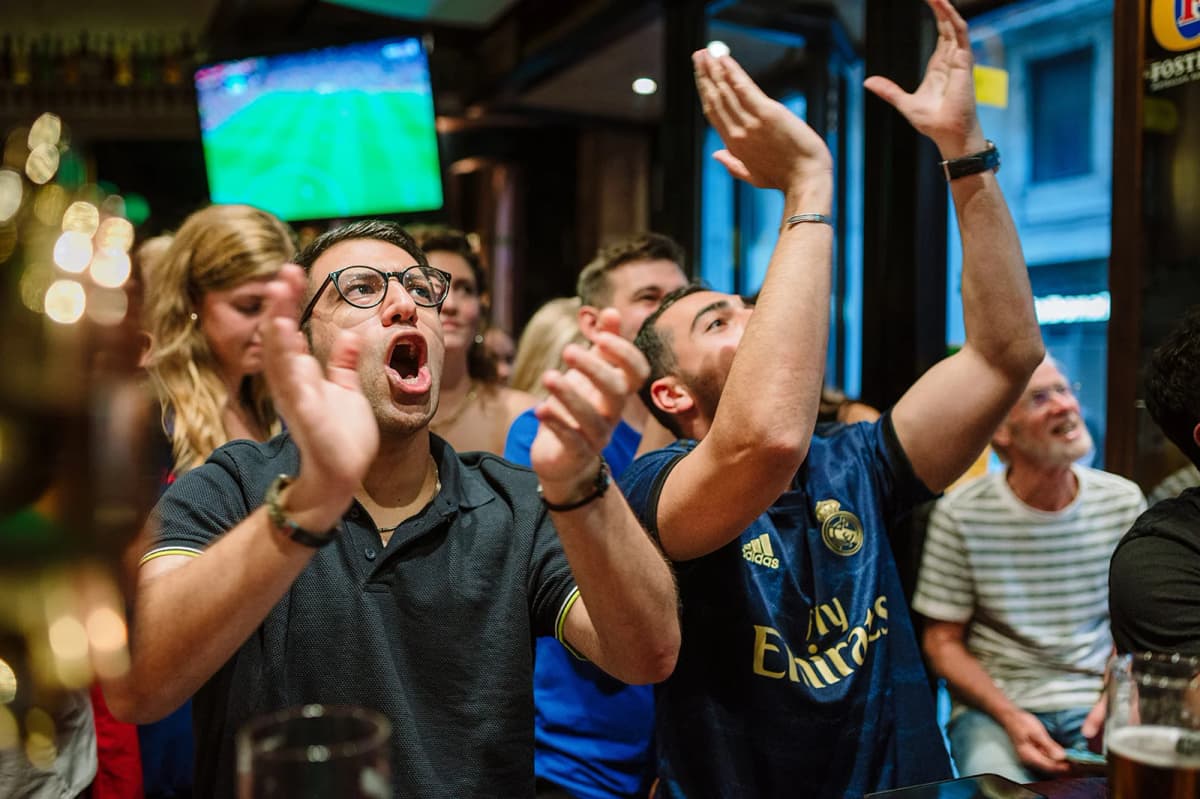
Broadcasting the Allianz League and the All-Ireland: Giant screens in a traditional dark wood pub atmosphere.
-
Gastronomy and Atmosphere: Burgers, shareable nachos, and a selection of craft and international beers to accompany the matches.