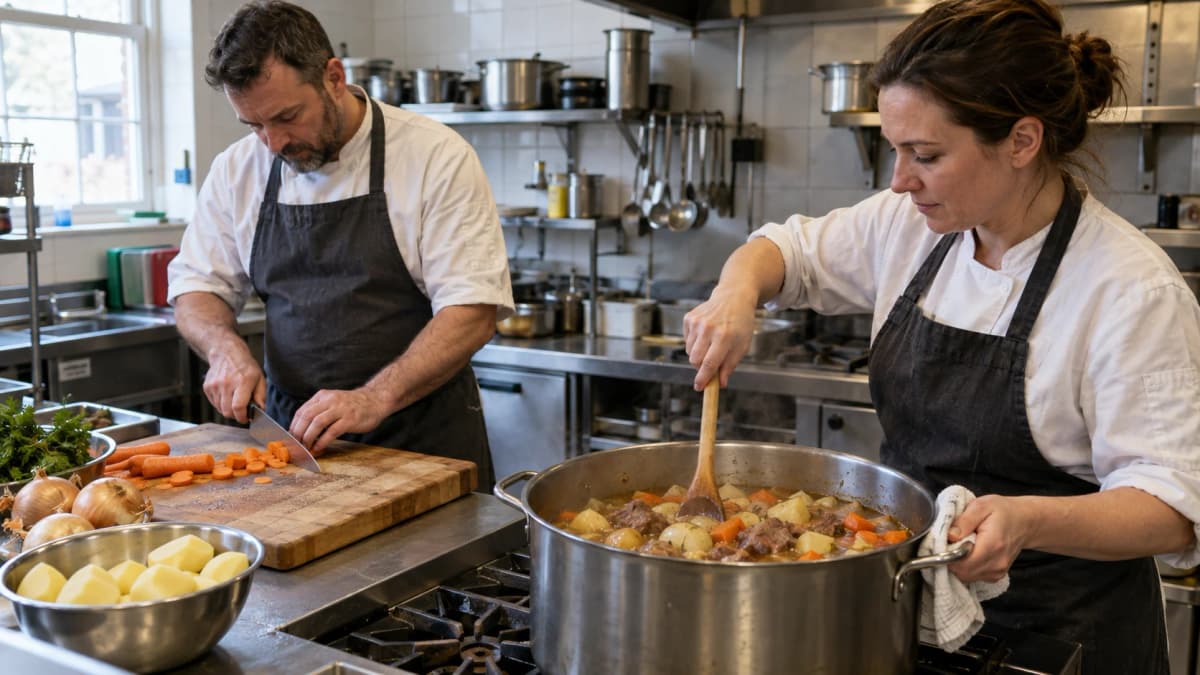
The Original Ingredients: The Rule of Three Elements
Historically, the purist recipe for Irish Stew only accepted three basic ingredients: mature sheep meat (mutton), potatoes, and onions, slowly cooked with water in a large cast-iron pot suspended over a peat fire.
-
The Use of Mature Meat (Mutton vs. Lamb): Unlike tender or young lamb, adult sheep meat was tough and very fatty, but accessible for rural families when the animal could no longer produce wool or milk. The only way to make this cut edible was to subject it to prolonged cooking over very low heat (more than 3 hours), which allowed the collagen in the connective tissue to hydrolyze and transform into natural gelatin.
-
The Potato as a Thermal Thickener: Introduced in Ireland in the late 16th century, the potato (Solanum tuberosum) adapted perfectly to the moist Irish soil. In the stew, part of the potatoes completely disintegrated during boiling, releasing starch and acting as a natural thickener for the broth without the need to add flours.
The Evolution Towards the Victorian and International Recipe
As the 19th century progressed and the economic situation improved unevenly, the recipe began to incorporate carrots, chives, and herbs such as thyme and parsley. Victorian cooks introduced the use of softer cuts of lamb (neck or shoulder) and began to gently brown the meat before boiling to activate the Maillard reaction, enriching the aromatic profile of the broth with toasted and caramelized notes.
Real Culinary Fact: In the classic book Three Men in a Boat (1889) by Jerome K. Jerome, there is a famous satire on how Irish Stew was the ultimate leftover dish, capable of absorbing any available ingredient in the pantry without losing its comforting character.
The Science of Slow-Cooked Stews
From a molecular standpoint, Irish Stew is a triumph of thermodynamics applied to cooking:
-
Gelatinization of Collagen: Between 60 °C and 70 °C, the tough fibers of the tough meat begin to denature. By maintaining a constant temperature just below the boiling point (about 85 °C - 90 °C), the insoluble collagen turns into soluble gelatin, providing a silky and smooth texture to the broth.
-
Extraction of Vegetable Aromas: Onions and carrots contribute fructose and sulfur compounds that, after hours of simmering, neutralize the rancid intensity of sheep fats, creating a deep and integrative umami flavor.
Sources