A story that begins long before the table
Food cannot be completely separated from history. People cook according to the available ingredients, the technology at their disposal, the climate, the economy, and social relationships. That’s why, when a preparation or a custom becomes a tradition, it usually does so after a long process.
In the case of this article, the starting point allows us to observe how a specific practice went from having a determined function to becoming part of a contemporary culinary experience. It is also important to distinguish between what is documented by institutions and what belongs to oral tradition or popular legends. An engaging story remains an engaging story even when acknowledging its limits.
The fact that changes the way we look at gastronomy
One of the most interesting aspects of this topic is that it demonstrates that eating is not just about ingesting food. The experience includes aromas, temperature, texture, sound, lighting, conversation, and memory. Research on the multisensory perception of food has shown that the brain integrates signals from different senses to construct the experience we identify as flavor.
This helps to understand why two meals with similar ingredients can feel completely different. Temperature modifies texture; aroma influences perception; the sound of the environment conditions attention; and company can turn an everyday meal into a significant memory.
Tradition, technique, and contemporary experience
Modern cuisine does not have to choose between tradition and innovation. An ancient technique can be applied with modern tools; a traditional product can be presented in a different way; and a contemporary space can recover a historical custom without turning it into a theatrical recreation of the past.
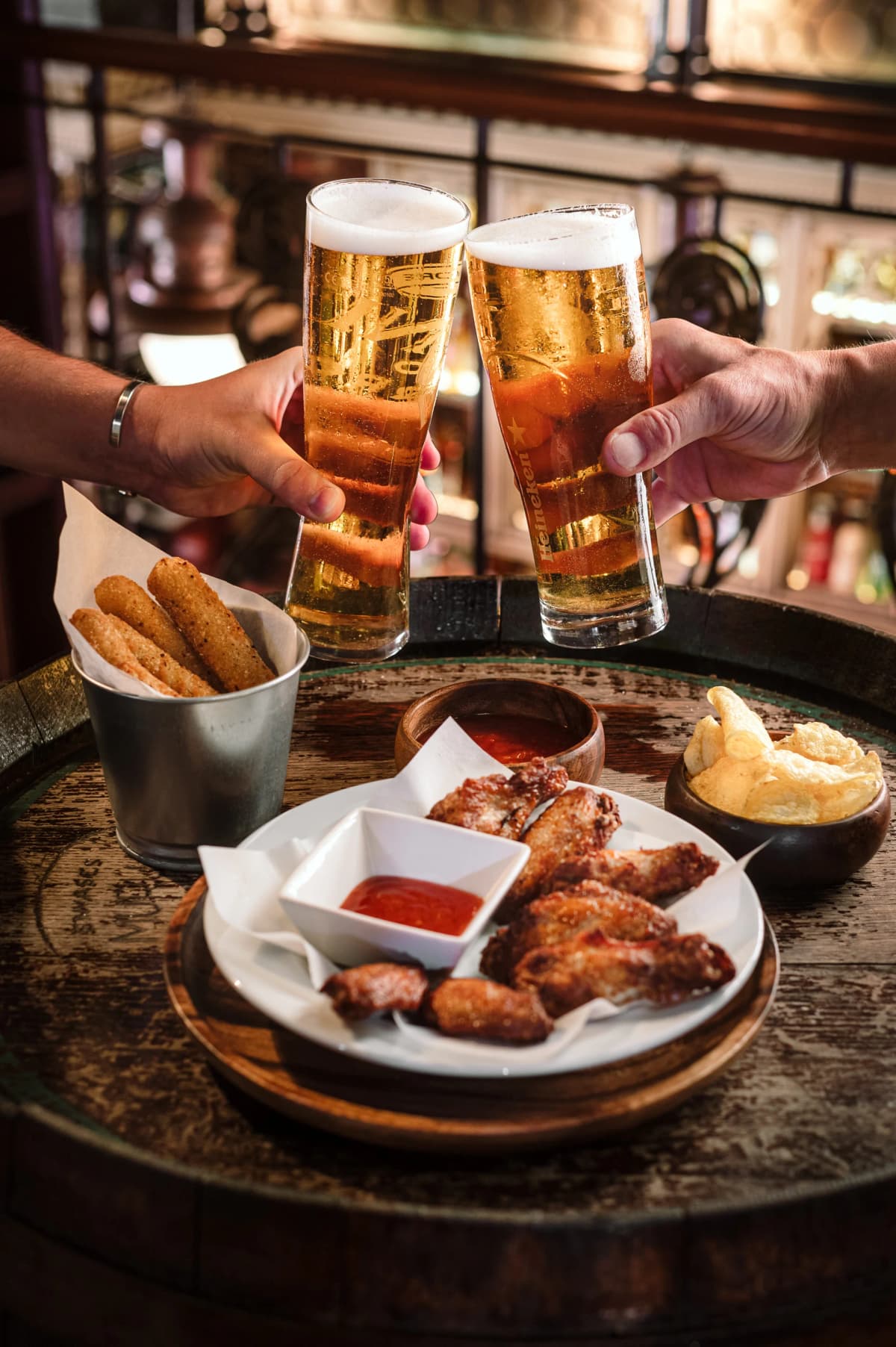
This balance is particularly interesting in TEMPLE BAR. An Irish pub in the center of Barcelona, with an identity linked to pub culture, sports, music, and Irish tradition. The relationship with this topic is not about claiming that the restaurant exactly reproduces a historical tradition, but rather about using it as a starting point to discuss a way of understanding the table: product, conversation, atmosphere, and enjoyment.
In a city like Barcelona, moreover, this combination takes on another dimension. The historic center serves as a meeting point between residents, travelers, and different culinary cultures. A dinner can start with an Italian, Mediterranean, or Irish reference and end up being part of a completely Barcelonian experience.
From history to the table
This perspective also explains why certain restaurants manage to generate a sense of identity. It does not depend solely on the recipe. Personality emerges when cooking, space, service, and context tell a coherent story.
In TEMPLE BAR, that connection can be experienced from a current perspective, a shared table, a long conversation, a cooking technique, a night in the historic center, or simply the opportunity to discover a detail that usually goes unnoticed.
Gastronomy has that special ability to turn information into experience. After learning the history of an ingredient, a technique, or a custom, the next time it appears on a table, it will no longer be perceived in exactly the same way.
One more reason to enjoy without haste
The best culinary experiences are not always the ones that happen the fastest. Reserving time to observe, converse, taste, and discover is also a way to travel through culture.
If you are looking for a place to turn a meal or dinner into a moment to share, discover, and enjoy the center of Barcelona, TEMPLE BAR offers a natural setting to do so.
Visit us.