The Botanical Revolution: The Arrival of Hops (Humulus lupulus)
For centuries, European beers did not use hops. To preserve and flavor the drink, a botanical mixture of wild herbs known as gruit (which included bog myrtle, yarrow, and rosemary) was employed.
It was in the monasteries of medieval Europe that the systematic use of the female flowers of hops (Humulus lupulus) was first documented.
-
The Contribution of Alpha Acid: Hops contain resins rich in alpha acids (such as humulone). When boiled, humulone is isomerized into isohumulone, providing two fundamental properties: a clean bitterness that balances the sweetness of the malt and a potent natural bacteriostatic effect that allowed beer to travel long distances without spoiling.
-
Volatile Aromas: The essential oils of hops (myrcene, humulene, and caryophyllene) release floral, herbal, and resinous notes upon contact with air, stimulating the retronasal olfaction before the first sip.
The Physics of Foam and the Descending Cascade
One of the most fascinating visual paradoxes in a traditional pub is the behavior of bubbles in beers poured with a mix of nitrogen and carbon dioxide (N2/CO2). When pouring the pint, the bubbles do not seem to rise: they cascade down the sides of the glass.
Why Do Bubbles Fall?
This phenomenon, studied by physicists at the University of Limerick (Ireland), is due to a fluid convection process:
-
Density in the Center: In the center of the glass, bubbles rise quickly due to buoyancy.
-
Perimetral Drag: As they rise massively in the center, the displaced liquid is pushed towards the walls of the glass and descends, dragging the small peripheral bubbles down with it.
-
The Role of Nitrogen (N2): Nitrogen is almost insoluble in liquid compared to CO2. This generates extremely small and stable microbubbles that form a dense, creamy, and long-lasting foam (known in English as head), which acts as a thermal seal protecting the drink from accelerated oxidation.
The Two-Step Ritual: From the Tap to Rest
In the culture of public houses, haste is the enemy of quality. The two-step service is not a commercial superstition, but a thermodynamic necessity.
-
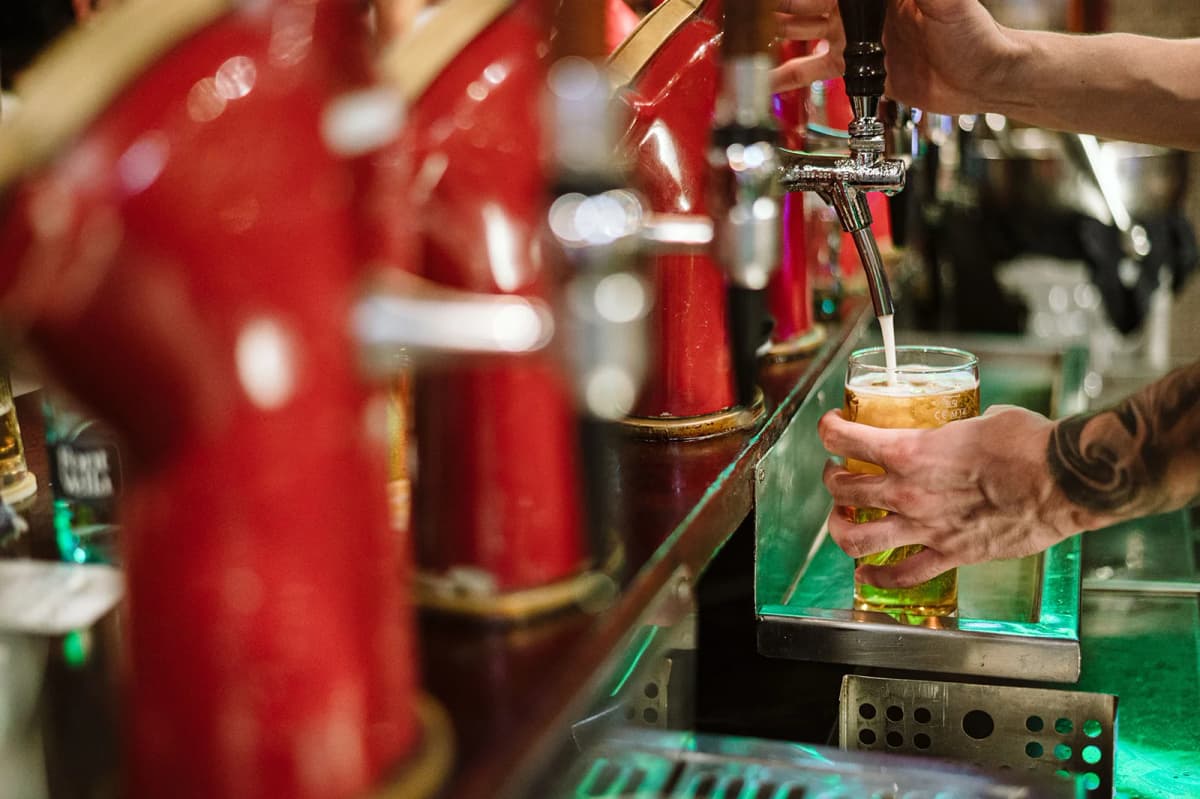
The First Pour (45 Degrees): The glass is tilted at 45° to reduce initial turbulence and allow the beer to slide smoothly down the glass without losing dissolved gas.
-
The Resting Period (The Settle): By tilting the glass and stopping the flow when it reaches three-quarters full, the microfoam is allowed to separate from the dense liquid. This rest aligns the colloidal structure of the malt proteins with the isohumulones from the hops.
-
The Final Touch: The tap is pushed back to release a slow, low-pressure flow that crowns the glass with a layer of perfect creaminess that slightly overhangs the edge.
The Science of Perfect Service in Temple Bar
In Temple Bar, in the heart of historic Barcelona, pouring a pint transcends the simple bar routine: it is a strict respect for brewing engineering and pub tradition.
From the precise control of barrel pressure and the temperature of the tap lines to the crystal-clear cleaning of the glasses to avoid unwanted nucleation points, every step is meticulously attended to. Enjoying a perfectly served pint or half-pint among wooden walls, a cozy atmosphere, and the rhythm of the city is to discover that science can also be savored.