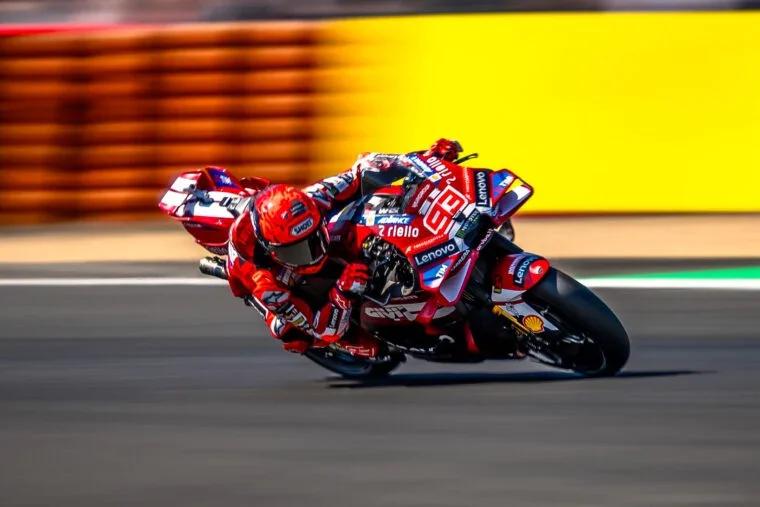
MotoGP and the Circuit de Catalunya: history, teams, riders and why this track matters so much
MotoGP is not just the premier class of motorcycle racing. It is one of the great narratives in modern sport: speed, technology, historic rivalries, legendary manufacturers and a style of competition that has turned every Grand Prix into a global spectacle. And if there is one stop on the calendar that helps explain that blend of tradition and technical demand, it is the Circuit de Barcelona-Catalunya.
Talking about MotoGP Catalunya means talking about one of the most recognisable rounds on the calendar, a track that truly tests riders and teams, and an environment that reflects the passion Spain and, in particular, Catalunya have for motorcycle racing. To understand why this Grand Prix matters so much, it helps to first look at the history of the championship, how it is structured, who defined its different eras and why the Catalan circuit remains such a genuine benchmark in the World Championship.
The history of MotoGP: a championship that began in 1949
The official history of the championship begins in 1949. The FIM notes that the first points-scoring race in the World Championship took place on 13 June 1949 at the Isle of Man, in the 350cc class. That was the birth of the world championship for circuit motorcycle racing, which would eventually become the benchmark competition in two-wheel motorsport.
According to the FIM and the official historical review by MotoGP, the championship was born with four solo motorcycle classes: 500cc, 350cc, 250cc and 125cc, plus sidecars. For decades, the premier class was 500cc. The modern MotoGP name came much later: the official MotoGP site explains that the MotoGP class officially replaced 500cc in 2002, ushering in a new era of four-stroke engines and a decisive technical evolution for the championship.
This matters because it helps explain something that is often simplified: MotoGP as a name and category is relatively recent, but the world championship it belongs to is the oldest motorcycle road racing championship in the world. That combination of legacy and renewal is one of the reasons it still holds such strong global appeal.
The technical evolution of MotoGP: from 500cc to the modern era
To really understand what makes MotoGP special, it is not enough to know its history. You also need to understand its technical evolution. For decades, the premier class was 500cc, an era defined by extremely fast, light and difficult-to-handle two-stroke machines. The major turning point came in 2002, when MotoGP officially replaced 500cc as the new premier category and brought four-stroke motorcycles back to the highest level of the championship, as the official MotoGP site itself recalls.
That change was not just a rules update. It was a complete transformation of the competition. The bikes developed more power, more electronics, more aerodynamic sophistication and a greater dependence on the team’s ability to interpret data, tyres, fuel consumption, stability and race management. In other words: the rider remained decisive, but the level of technical complexity rose dramatically.
That is why, when we talk about MotoGP today, we are also talking about elite engineering. Every race weekend becomes a battle between manufacturers, technical departments, setup strategy and very different riding styles. That combination explains why MotoGP is not seen simply as fast motorcycle racing, but as one of the most technically advanced competitions in motorsport.
How the MotoGP world is structured today
Today, when we talk about the championship, we are mainly talking about three key steps: MotoGP, Moto2 and Moto3. The official MotoGP site clearly explains the logic of these categories: Moto3 works as the entry point for young talent; Moto2 as the major transition class; and MotoGP as the summit, where media pressure, maximum technical development and the most influential riders all come together.
In practice, that means MotoGP is not just “the fastest category”, but the place where the following meet:
- factory manufacturers with huge technological investment,
- satellite teams capable of winning races,
- riders with enormous competitive and media influence,
- a global narrative built on titles, rivalries and constant evolution.
It is also worth remembering that the modern championship is not explained by the bikes alone. It is shaped by the interaction between the FIM, IRTA, MSMA and Dorna, something the FIM itself highlights when discussing the championship’s development since the 1990s. That coordination has been essential in making MotoGP more professional, safer and more attractive for both fans and manufacturers.
What a MotoGP race weekend is really like
Another important point is that MotoGP is not just about the Sunday race. The modern championship unfolds as a competitive process built across the entire weekend. Practice sessions, qualifying, technical adjustments, the sprint and the main race all form part of a sporting narrative that rewards both outright speed and consistency.
From the fan’s point of view, that changes the experience completely. It is no longer only about who wins, but about watching how each rider develops, which team finds the right setup first, who manages the rear tyre best, who takes the biggest qualifying risk and who can handle pressure when it is time to turn pace into result. That tactical richness is one of the reasons MotoGP remains so compelling even for people who do not follow every round of the season.
The most famous teams in MotoGP
If you look at the history of the championship, some names keep appearing because they defined entire eras. Honda and Yamaha have been two of the central pillars of the World Championship for decades. The FIM itself notes that Honda is the constructor with the most Grand Prix wins, which sums up its historical weight very well. Alongside them is Ducati, which evolved from a manufacturer with occasional victories into a technical and competitive benchmark of the modern championship; Aprilia, with strong heritage in the smaller classes and increasing weight in the premier class; and KTM, whose growth in MotoGP has been one of the most significant competitive developments of recent years.
On the current 2026 grid, according to the official team and rider list on MotoGP, the most recognisable and influential structures are Ducati Lenovo Team, Honda HRC Castrol, Monster Energy Yamaha MotoGP, Aprilia Racing and Red Bull KTM Factory Racing. Alongside them, teams such as Pertamina Enduro VR46 Racing Team, BK8 Gresini Racing MotoGP, Prima Pramac Yamaha MotoGP, Castrol Honda LCR and Trackhouse MotoGP Team also carry major relevance.
This matters because it helps the reader understand one of the modern championship’s most important traits: the big factory name does not always win on its own. In today’s MotoGP, strong satellite structures and well-balanced projects can completely alter the competitive order of a season.

The historic riders who changed MotoGP
No story about MotoGP makes sense without its great riders. The official Hall of Fame section and the gallery of MotoGP Legends make it very clear who defined each era.
Among the unavoidable names is Giacomo Agostini, an absolute benchmark in motorcycle racing because of his titles, victories and historic impact. Then there is Valentino Rossi, whose sporting and media influence transformed the championship and took it to mass audiences inside and outside Europe. When the official MotoGP site announced him as a MotoGP Legend, it summarised a career that is extraordinarily difficult to match: nine world titles, 115 wins and 235 podiums across all classes.
Alongside them are other names that matter if the article is to feel genuinely authoritative: Mick Doohan, Wayne Rainey, Kenny Roberts, Casey Stoner, Jorge Lorenzo, Dani Pedrosa, Ángel Nieto and Mike Hailwood. Each represents a different chapter of the championship: professionalisation, technical revolution, global growth, media rivalry or the refinement of modern riding styles.
A strong article on MotoGP history should not simply list those names. What matters is understanding what they contributed. Agostini symbolises classic dominance. Rossi turned the championship into a global cultural phenomenon. Stoner and Lorenzo represent technical precision and competitive excellence. Pedrosa, even without a premier-class crown, is a figure of enormous prestige inside the paddock. And Marquez takes the category into a new dimension of aggression, control and reading the limit.
The most influential current riders
If we look at the grid as of 14 May 2026, influence is not measured only by titles. It is measured by competitive ability, media magnetism and weight within the championship narrative.
Within that group, Marc Marquez remains a central figure. Recent MotoGP coverage still places him as one of the emotional and sporting poles of the championship, even in difficult weeks such as the build-up to the 2026 Catalan GP, when Ducati officially confirmed there would be no replacement following his operation. Alongside him is Francesco Bagnaia, Ducati Lenovo Team’s key competitive and technical leader. We should also include Marco Bezzecchi, who arrives as one of the strongest present-day references; Fabio Quartararo, because of his value as a champion and his continuing significance for Yamaha; Jorge Martin, a recent champion and a key name in the modern era; and Pedro Acosta, who represents the major consolidated promise of the next cycle.
This blend is precisely what keeps MotoGP so attractive: living legends, recent champions, young challengers and manufacturers that need results to sustain their competitive identity.
When the Circuit de Barcelona-Catalunya joined the calendar
The Circuit de Barcelona-Catalunya holds a special place in the championship because it combines history, continuity and technical difficulty. The official event page on MotoGP makes one key fact very clear: the circuit has hosted a World Championship Grand Prix since it joined the calendar in 1992, and it has done so without interruption ever since.
That means much more than a date. It means Catalunya is not an occasional venue or a modern addition, but one of the most established circuits of the contemporary World Championship. The track officially opened in September 1991, as reflected in the circuit’s own documentation and public information, and in a very short time it became part of the permanent calendar of elite motorsport.
What the Circuit de Barcelona-Catalunya is like
The official Catalan GP event page on MotoGP and the technical information from the Circuit de Barcelona-Catalunya describe a very distinctive track: 4.657 km in length, 14 corners, 8 right-handers and 6 left-handers, plus a main straight of 1,047 metres. It does not look extreme in just one area, and that is exactly what makes it so demanding: it asks a lot in acceleration, braking, stability and the overall balance of the motorcycle.
It is a track that punishes setup mistakes and exposes weaknesses. If a bike lacks traction, it shows. If it struggles to turn, it shows. If the rider cannot sustain rhythm and precision while carrying lean angle, that also shows. That is why it is one of those circuits where performance is often read as “real”: it is difficult to hide limitations here.

If you want more visual context, the official MotoGP event page also includes a “Watch Track Lap” section, which is useful for understanding how the key sectors of the circuit flow together.
What makes the Circuit de Barcelona-Catalunya so demanding
The Circuit de Barcelona-Catalunya is respected because it is one of those tracks that forces the bike to be complete. It does not heavily favour a single strength. It is not enough to be very fast on the straight or brilliant under one type of braking. What usually makes the difference is overall balance: corner speed, stability, acceleration, tyre management and the rider’s ability to maintain pace without overloading the machine.
The official event page on MotoGP and the technical information from the Circuit de Barcelona-Catalunya confirm a layout of 4.657 km, with 14 corners and a 1,047-metre main straight. On paper, that may look like a simple collection of numbers, but on track it becomes a layout that is highly sensitive to rider confidence and the quality of the bike-tyre package.
In addition, Catalunya has special value because it tends to provide a very honest reading of a project’s real level. When a bike performs well here, the paddock notices. And when a rider stands out at this circuit, it is usually not seen as luck, but as a clear sign of competitiveness and adaptation.
Catalunya as the setting for moments that define seasons
The great circuits matter not only because of their design, but because of what they represent within the championship. Catalunya is one of those tracks that has repeatedly acted as a turning point for riders, factories and seasonal trends. MotoGP’s own recent history makes this clear: it is a venue where symbolic victories, dominant weekends and moments of enormous emotional impact for the paddock have all taken place.
That reinforces its importance within the calendar. The Catalan Grand Prix is not a secondary stop or a simple local event. It is an established, respected and closely watched round for teams, riders and fans. It has tradition, continuity and a very strong connection with the culture of motorcycle racing in Spain. Within the championship narrative, that gives it a value that goes beyond Sunday’s result.
There is another important factor too: the circuit has also been the scene of significant safety-related changes. In 2016, following the fatal accident of Luis Salom, MotoGP announced permanent modifications to the track’s Grand Prix layout. This point matters because it shows that the championship evolves not only in spectacle, but also in risk management and in adapting the competitive environment.
Why Catalunya matters so much in the championship
The importance of the Circuit de Barcelona-Catalunya is not limited to its figures. It matters because it is one of the venues that best sums up what MotoGP genuinely demands. Technically, it is a full examination. Competitively, it tends to separate balanced bikes from those that depend too heavily on a single strength. Emotionally, it is a round with symbolic weight because it connects directly to one of the strongest talent pools in world motorcycle racing.
The official MotoGP site itself points out that the circuit is practically “home” for many of the championship’s stars. That is not a minor detail. Catalunya is part of the story of riders such as Marc Marquez, Jorge Lorenzo, Dani Pedrosa, Maverick Viñales, Aleix Espargaró and Pol Espargaró. That gives the Grand Prix an added layer of meaning: here, the local crowd is not decoration, but part of the event’s identity.
Why MotoGP is so compelling even for people who do not follow every round
Part of MotoGP’s power is that you do not need to be an expert to feel its intensity. The noise, the speed, the overtakes, the tiny margins, the tension of each lap and the human side of the riders all make the spectacle work even at first contact. But the more context a viewer has, the richer the experience becomes.
That is exactly what a good article should achieve: not only saying that MotoGP is important, but explaining why it is important. In that sense, Catalunya works almost like an ideal gateway. It has the technical level, the history, the symbolic weight and the emotional connection needed to summarise everything that makes the championship great.
A Grand Prix that explains very well what MotoGP is
If you had to choose one round to explain why MotoGP remains one of the most attractive championships in motorsport, Catalunya would be a very strong candidate. It has history, tradition, riders closely linked to the area, continuity in the calendar and a layout demanding enough for genuine performance to speak for itself.
That is why, when someone searches for information about MotoGP Catalunya, they are usually looking for something larger: understanding the championship, recognising its protagonists, knowing why this round matters and entering the logic of a sport that blends technical precision, bravery and legacy like very few others.
Experience the Grand Prix with more context and more emotion
When you understand how MotoGP has evolved, why its teams and riders define eras and what makes the Circuit de Barcelona-Catalunya such a demanding test, the race feels different. You are no longer just watching fast bikes: you are watching strategy, history, talent and one of the most intense championships in world sport.
And if you want to follow the championship this weekend with the kind of atmosphere a round like this deserves, Temple Bar lets you enjoy live sport with screens, race-day energy and an atmosphere built to share every lap.
Want to watch MotoGP with real atmosphere in Barcelona?
Check Temple Bar’s sports schedule and come enjoy the next Grand Prix with screens, a great atmosphere and everything that makes a race weekend special.