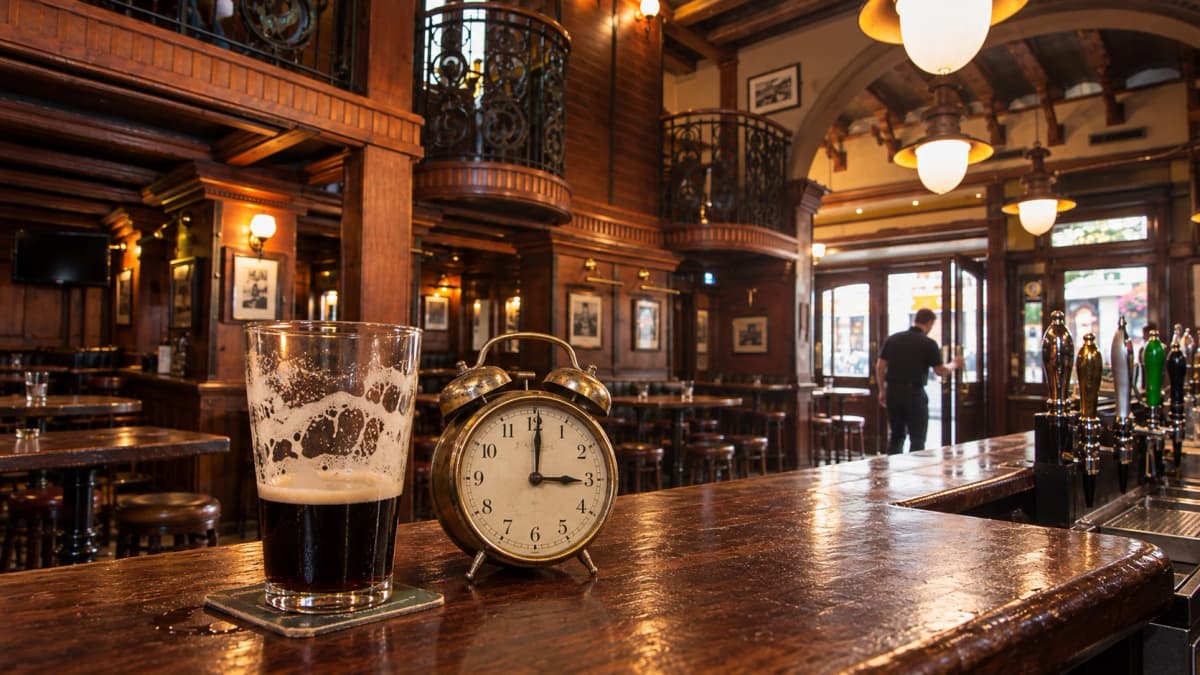
A wartime measure that stayed to live
The origin of the idea is not Irish, but British and wartime. During World War I, the UK government restricted pub hours due to a very specific concern; that factory workers producing ammunition would drink during their midday break and return to work in poor condition.
When the Irish Free State gained independence, it inherited a mosaic of British regulations regarding licenses. Instead of dismantling it, it reorganized it. The Intoxicating Liquor Act of 1927, pushed during the tenure of Justice Minister Kevin O’Higgins, consolidated that mandatory afternoon closure into Irish legislation. The official argument was the same as in 1914, to get people back to work after lunch.
The name, on the other hand, was pure popular ingenuity. Calling a forced closure a holy hour by borrowing the term from a Catholic devotional practice of reflection summarizes quite well the Irish humor and also the weight that the Church had at that time in public life.
Where it was applied, and where it was not
This is the detail that is almost always misreported; the “holy hour” never affected all of Ireland. The data, collected in Irish parliamentary debates, is concrete.
-
It was applied in four cities: Dublin, Cork, Limerick, and Waterford.
-
The mandatory closing time was from 2:30 PM to 3:30 PM on weekdays.
-
In 1962, it was abolished in Limerick and Waterford, leaving only Dublin and Cork under the rule.
-
It affected both licensed establishments and private clubs.
That is to say, for more than two decades, the hour at which you could have a drink in Ireland literally depended on which city you were in.
How a law created a tradition?
Anyone who has stepped into a pub senses what happened. The rule did not eliminate the afternoon drinking; it displaced it and, in a way, made it more attractive.
In practice, the “holy hour” had two well-documented consequences. The first, the most visible, was groups of customers waiting on the sidewalk for the establishment to reopen, resulting in having swapped a chair for a curb. The second, the most famous, was the lock-in, the custom of patrons discreetly staying inside, with the door closed, often gathered in the snug at the back of the establishment.
This second practice eventually became an identity element of Irish pub culture, to the point that today it is celebrated as a tradition something that was born as a way to evade a prohibition.
The legal loophole that everyone knew
Even before the “holy hour” was abolished, Irish legislation carried another equally famous loophole: the figure of the “bona fide traveller.” This rule, inherited from the days of horse-drawn carriages, allowed anyone who had traveled a minimum distance from their place of lodging—three miles in general, five in Dublin and other large cities—to drink outside legal hours, including Sunday closures and the “holy hour” itself.
The practical application was as clever as it was predictable. It was enough to demonstrate that one had traveled in good faith and not solely for the purpose of drinking, so generations of Irish people turned the Sunday stroll into a meticulously calculated pilgrimage to cross the mileage limit. Some even sent themselves a letter to a friend's address that lived at the regulatory distance, to be able to show it as proof if the bartender asked.
The law did not distinguish between real good faith and feigned good faith, so the responsibility to prove bad faith fell on the establishment itself. The result was a new and unplanned geography; towns situated right at the distance limit from cities saw their hospitality business flourish on Sunday afternoons, while silence reigned within the prohibited radius. This loophole, distinct from the “holy hour” but of the same legal family, was not completely closed until 1943 in its most permissive form, and its echoes continued to be felt well into the second half of the century. The very British parliamentary debate of the early 20th century reflects the contentious nature of the exact limit, which was set at three miles for most of the country, five for Dublin and other large cities, and even unsuccessfully proposed to extend it to six miles on Saturdays.
Over time, some of those pubs located right at the regulatory limit became prosperous businesses and part of the national anecdote, still cited today as a perfect example of how a rule designed to control consumption ended up, in practice, organizing the leisure of half the country around a map of distances.
1988 and 2000: the end in two phases
The dismantling was gradual and occurred in two clearly differentiated phases.
-
1988. The Intoxicating Liquor Act of that year abolished the “holy hour” on weekdays in Dublin and Cork, the last two territories where it was still in effect. The minister's argument before the Seanad was twofold: to unify hours across the country and to recognize that the rule had become obsolete, partly due to the growing custom of eating at midday in licensed establishments and partly due to its negative effect on tourism and commercial activity.
-
2000. The new Intoxicating Liquor Act eliminated the Sunday afternoon closure, which remained between 2:00 PM and 4:00 PM and which many people still referred to as the “holy hour.” This same reform updated more than fifty regulations, some of them centuries old.
Interestingly, the expression survived the law. In current Irish English, “holy hour” can designate any imposed and tedious pause: a senseless wait, a meeting that does not progress, a delay that no one can explain.
Why this story matters
Beyond the legal curiosity, the “holy hour” tells something about the pub as an institution.
-
The pub was never just a place to drink. It was legislated because the State understood it was a central social space.
-
The rules about hours reveal what each era feared and valued.
-
Pub culture has shown a remarkable ability to absorb restrictions and turn them into its own rituals.
No holy hour in the Gothic Quarter
In Temple Bar Barcelona, there is no holy hour. The two establishments in the Gothic Quarter, Ferran 6 and Avinyó 9, open from noon and continue until dawn, with the atmosphere, pub food, and live sports that are part of the same cultural package we have been discussing.
That conversation that in Dublin in 1955 would have been interrupted at two-thirty can continue here as long as needed. It is probably the best way to honor a tradition: by staying.
Come to Temple Bar, at Carrer Ferran 6 or Carrer d’Avinyó 9, and see what happens when no one asks you to leave in the afternoon. Check the sports and events schedule on the website.
Sources
- Houses of the Oireachtas — Seanad Éireann debate on the Intoxicating Liquor Bill, May 26, 1988
- Irish Statute Book — Intoxicating Liquor Act, 1988
- RTÉ Archives — Calling Time On Holy Hour
- The Irish Times — Longer pub opening hours come into operation today (2000 reform)
- The Irish Times — 10 things you might not know about Irish pubs (the figure of the “bona fide traveller”)